Discover the Spirit of Old Dubai & Historic Creek
Old Dubai represents the living ancestral cradle and trading soul of the emirate. Spanning both banks of the natural saltwater Dubai Creek, this historic quarter encompasses the atmospheric districts of Bur Dubai and Deira. Long before the advent of modern glass skyscrapers, Dubai flourished here as a bustling maritime hub where pearl divers and dhow merchants traded silks, frankincense, and spices with Persia, India, and East Africa. Today, Old Dubai preserves this heritage through coral-stone wind-tower architecture, winding alleyways (sikkas), historic abra boats, and vibrant open-air bazaars.
The history of modern Dubai begins along the shores of Dubai Creek (Khor Dubai), a natural seawater inlet that cuts nine miles into the mainland. In 1833, eight hundred members of the Bani Yas tribe, led by the Al Maktoum family, settled at the mouth of the creek, establishing Dubai as an independent seafaring community. The creek provided natural shelter for wooden pearling fleets and merchant dhows, fostering an open-market mercantile culture that earned Dubai the reputation as the 'City of Merchants'.
On the southern shore lies Bur Dubai, home to the Al Fahidi Historical Neighbourhood. Built in the late 19th century by wealthy pearl merchants from Bastak in southern Persia, the district is characterized by sand-colored houses constructed from coral stone, gypsum, and teak wood. The architectural marvel of these residences is the barajeel—ingenious four-sided wind towers that catch cooling sea breezes and funnel them downward into living quarters, functioning as an ancient passive air conditioning system. Today, these restored structures house art galleries, boutique museums, and leafy courtyard cafes.
Crossing Dubai Creek is a timeless cultural ritual. For just one dirham, passengers step onto traditional motorized wooden watercraft known as abras, crossing between the bustling wharves of Bur Dubai and Deira. Along the creek docks, hand-carved wooden cargo dhows are still loaded by hand with appliances, textiles, and spices bound for ports across the Indian Ocean, preserving maritime routines unchanged for decades.
On the northern shore of Deira lies Dubai's historic commercial pulse: the traditional souks. The Deira Gold Souk features over three hundred retail shops with windows gleaming with millions of dollars in 22-karat and 24-karat gold jewelry, all strictly hallmarked and inspected by Dubai Municipal laboratories. Steps away, the Deira Spice Souk fills the narrow shaded alleyways with intoxicating aromas of dried rosebuds, frankincense resin, turmeric, and prized Iranian saffron, inviting travelers to practice the polite art of Middle Eastern bargaining.
Key Highlights in Old Dubai & Historic Creek
Top Activities in Old Dubai & Historic Creek
Experience the finest attractions, cultural discoveries, and outdoor adventures in this iconic district.
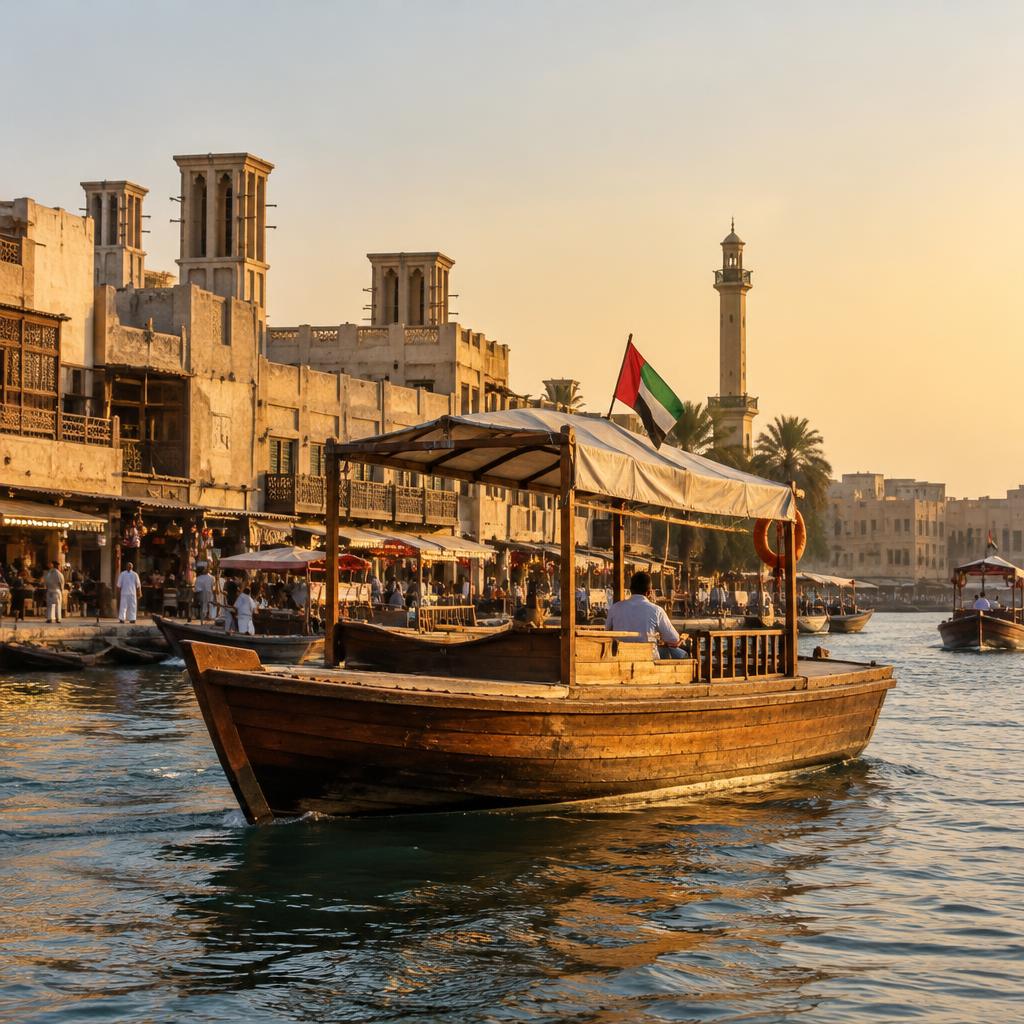
Traditional Wooden Abra Ride on Dubai Creek
Glide across historic saltwater channels between Bur Dubai and Deira on a motorized wooden water taxi.
Riding an abra across Dubai Creek is one of the most authentic, inexpensive, and cherished experiences in the United Arab Emirates. More than 150 motorized wooden vessels shuttle back and forth continuously across the saltwater inlet, carrying over 50,000 commuters and visitors daily. Passengers sit centrally on a wooden bench facing outwards as the boat chugs through gentle waves, passing wooden cargo dhows, heritage wind towers, and seabirds soaring in the breeze.
- Iconic historic transit experience costing only 1 AED (cash paid directly to the boat captain)
- Panoramic open-air views of minarets, dhow wharves, and traditional heritage architecture
- Seamless crossing between the Textile Souk in Bur Dubai and the Spice Souk in Deira
- Option to charter a private abra for a 60-minute private creek cruise at very affordable rates
Deira Gold Souk 22K & 24K Jewelry Walk
Marvel at monumental bridal jewelry, diamond suites, and the world's heaviest gold ring.
The Deira Gold Souk is an astonishing market housing hundreds of licensed jewelers under traditional wooden pergolas. It is estimated that up to ten tons of gold is present in the market at any given time. Visitors can marvel at the Najmat Taiba (Star of Taiba), recognized by Guinness World Records as the heaviest gold ring in the world, weighing 64 kilograms and studded with Swarovski crystals. Shoppers can purchase certified gold jewelry priced transparently by daily market weight plus craftsmanship fees.
- Over 300 reputable jewelry retailers specializing in 18K, 21K, 22K, and 24K gold
- Guaranteed gold purity monitored by daily inspections from Dubai Central Laboratories
- Viewing the Guinness World Record 64-kilogram Star of Taiba gold ring
- Friendly, polite negotiation on craftsmanship making charges with seasoned merchants
Deira Spice & Oud Perfume Bazaar Exploration
Engage your senses with sacks of frankincense, saffron, dried limes, and pure Arabian attars.
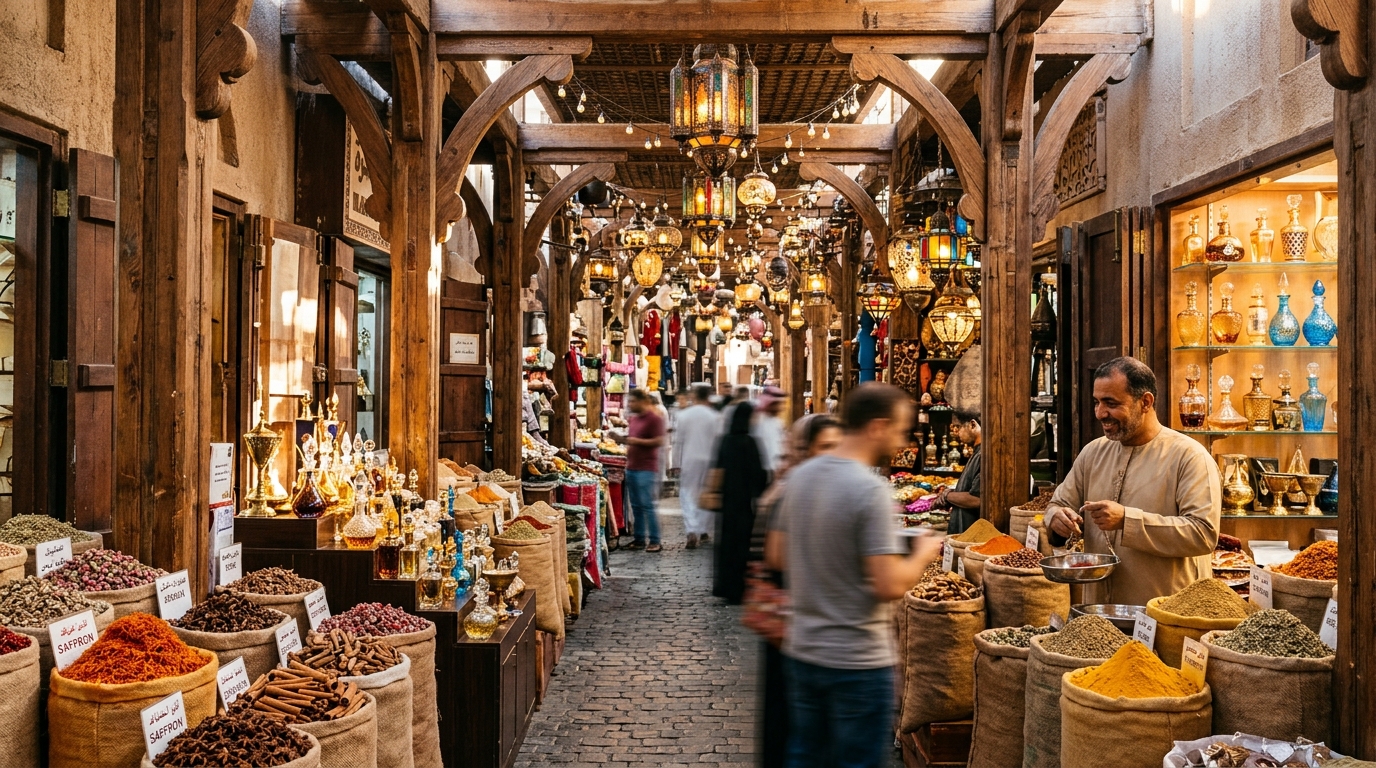
Steps from the abra docks, the Deira Spice Souk is an intoxicating sensory kaleidoscope. Narrow alleyways are filled with burlap sacks heaped high with vibrant golden turmeric, whole star anise, aromatic cinnamon sticks, dried Persian black limes (loomi), and prized Grade-1 saffron threads. Friendly merchants invite passersby to sample dried dates, inhale Omani frankincense burning on charcoal censers, and formulate custom Arabian perfume oils (oud and musk) tailored to personal tastes.
- Heaped sacks of imported culinary spices, dried medicinal herbs, and rare tea infusions
- Learning the sensory tests to identify genuine high-grade Super Negin Persian saffron
- Custom-blending concentrated alcohol-free Arabian perfume oils (attar) and pure aged oud
- Vibrant photographic backdrops of rustic wooden beams, hanging lanterns, and colorful sacks
Al Fahidi Historical Neighbourhood Walking Tour
Wander through labyrinthine sikkas, coral-stone houses, and barajeel wind towers in 19th-century Old Dubai.
The Al Fahidi Historical Neighbourhood is Dubai's best-preserved historic quarter. Constructed in the 1890s, the district features fifty restored residences constructed from coral rock quarried from the creek bed, held together by mud and gypsum plaster. Visitors stroll along winding narrow pedestrian corridors (sikkas) beneath towering barajeel wind towers, discovering independent art spaces like the XVA Gallery, the Coins Museum, the Calligraphy House, and shady courtyard cafes shaded by bougainvillea.
- Intact 19th-century wind-tower houses showcasing passive desert cooling architecture
- Art galleries showcasing contemporary Middle Eastern painting, photography, and sculpture
- The Coins Museum displaying rare early Islamic dinars and dirhams from regional caliphates
- Peaceful courtyard cafes serving fresh saffron tea, mint lemonade, and cardamom pastries
Al Shindagha Museum & Perfume House
Explore the historic royal residences of the Al Maktoum family and Emirati heritage pavilions.
Al Shindagha Museum is the UAE's largest open-air heritage museum, spanning over twenty restored pavilions situated along Dubai Creek. Centered around the historic residence of Sheikh Saeed Al Maktoum (Ruler of Dubai from 1912 to 1958), the museum utilizes cutting-edge multimedia projections to narrate Dubai's evolution from a pearling settlement into a global metropolis. The dedicated Perfume House immerses visitors in the 3,000-year history of Arabian scents, showcasing rare ambergris, deer musk, and antique distillation equipment.
- Historic palace of Sheikh Saeed Al Maktoum with antique photographs and royal artifacts
- Interactive multimedia pavilion: 'Dubai Creek: Birth of a City' featuring cinematic mapping
- The Perfume House showcasing traditional Emirati scent preparation and botanical distillation
- Traditional Craft Pavilion with live demonstrations of metal forging, rope making, and weaving
Neighborhoods of Old Dubai & Historic Creek
Al Fahidi Historical Quarter
The premier preserved heritage district with fifty coral-stone wind-tower houses, hidden art galleries, and the Sheikh Mohammed Centre for Cultural Understanding.
Deira Souks & Al Ras
The lively commercial trading docks along the northern bank, home to the world-famous Gold, Spice, Perfume, and Utensil souks.
Al Shindagha Waterfront
The historic royal waterfront enclave where Dubai's rulers once resided, now converted into the expansive multi-pavilion Al Shindagha Museum.
How to Get to Old Dubai & Historic Creek
Old Dubai is exceptionally well-served by public transit. The Dubai Metro Green Line provides direct access via Al Fahidi Station (for the heritage quarter), Al Ghubaiba Station (for Shindagha and the bus terminal), and Al Ras Station (for the Gold and Spice Souks). Abras cross continuously between Bur Dubai Marine Station and Deira Old Souk Marine Station for 1 AED. Metered RTA taxis are plentiful, and paid RTA parking bays are available throughout the perimeter.
Where to Eat & Drink in Old Dubai & Historic Creek
Old Dubai is a culinary goldmine for authentic, affordable dining. In Al Fahidi, the Arabian Tea House offers traditional Emirati breakfast platters under white rattan canopies. In Deira, the legendary Shabestan inside the Radisson Blu serves Persian saffron kebabs with panoramic creek views. The backstreets of Al Ras and Karama dish up street-food delicacies including Iranian sangak bread fresh from stone ovens, piping hot falafel, and fragrant chicken biryani.